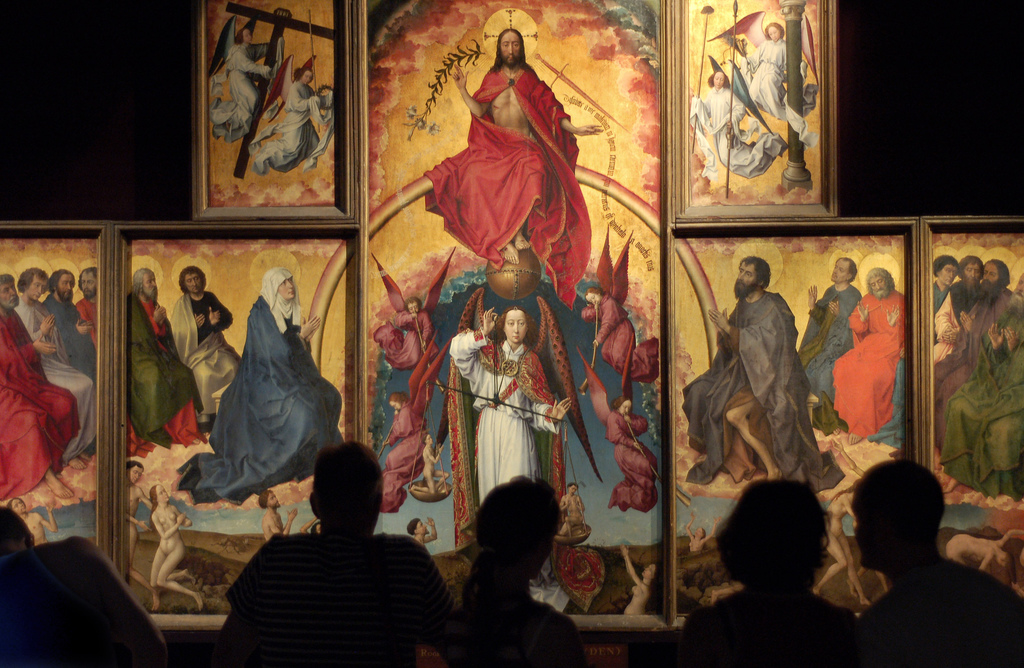
Towards the end of Matthew's Gospel, and as we end this liturgical year, we begin to think about the 'end times.' I was looking at a web-site the other night which detailed the times throughout history that the world was supposed to have ended. About this time people get more religious and start looking for faith in their lives. In recent months, and I believe it has something to do with our present cultural chaos, there have been a number of movies on demonic possession and evil spirits.
All of this can be pretty frightening and certainly even the most faith filled person might find themselves a bit perplexed. Matthew though looks at the challenges of our faith in a very different way. There will be confrontations and oppositions to our belief and faith throughout our days. Now we can choose to ignore these difficulties, or squelch our faith to such a degree that it is barely recognizable. But when we pronounce our faith we leave ourselves open to all sorts of hostility and brokenness. It might even seem like the end of the world.
I found this neat reflection which I used for my homily last weekend. It was entitled a 'Franciscan Blessing.' The prayer invited us to be bothered by oppression, hunger, hurt, and despair. It asked that we never be comfortable. As a Christian, we should be disturbed by a lack of peace and human dignity. Jesus did not have a quota of healing and miracles to do, he responded to the needs that presented themselves.
Faithful disciples look forward to the coming of God's kingdom, with our eyes towards heaven, but our feet firmly planted on the ground. I remember listening to a woman who stated that she was a mystic. But throughout the conversation she seemed angry and hostile. When I suggested that being a mystic should fill one with peace and joy, she became even more belligerent. Holy people are not put off from doing holy things when they hear about distress. All the more they are strengthened by their faith and relationship with Jesus the Christ.
Our participation in the mysteries we celebrate gives us the insight and courage to proclaim Jesus even during frustrating times. Like the first disciples we are told not to worry about our speech since it will be the spirit speaking within us. It is this truth that sets the modus operandi of our response to God and others in our world today. Like any good Jesus Freak we should be concerned that justice and peace are proclaimed. We work to give witness of the very foundation of our faith. So that in the end people might hear good news and be moved by it.
Wednesday, November 23, 2011
Monday, November 21, 2011
Faith Opens us to Truth
Way back in September, Bishop William Lori, of Bridgeport, Conn. celebrated a Red Mass at his Cathedral. The Red Mass is traditionally celebrated for persons involved in the legal profession. In using Luke's Gospel.Bishop Lori began framing his homily along the path of the 'Spirit of God.' Bishop Lori reminded the faithful members of the legal profession that we were indeed strengthened with the Holy Spirit at Baptism and Confirmation. This very action unites us more closely with the Paschal Mystery which we celebrate each and every time we do the Mass.
Lori used Cardinal John Henry Newman to demonstrate the connection between faith, and our obligation in seeking out the truth. Lori states, "Newman's witness to the fullness of Christian truth brought many to the Church and profoundly affected the culture of his day." Just as Cardinal Newman displayed a propensity to find the truth in all situations, in our own lives, personal and public, we are to seek out what is true and good. Lori reminded those present that this necessity had importance for our own moral character, and because of our public nature human life itself.
An important challenge that Lori gave his listeners is where he intones the late John F. Kennedy, "The rights of Man come not from the generosity of the state, but from the hand of God." In our post-modern society I tend to think that we have forgotten this very basic truth. God gives us every good thing, and maintains and sustains our lives. We like to believe that we can legislate morals and ethics. It is a mentality that believes that if it is legal, or we think that it is in the constitution, when then it must be right.
I have come to know our state representative for the DeKalb area. Recently there was some legislation which was supposed to help one of the many problems within the state. He did not support it, and even wrote an editorial explaining his reasons. He bristles at legislation based solely on emotions or good feelings. Something will happen which causes people to declare together, "There ought to be a law." But as Bishop Lori would suggest, and as our Gospels proclaim, how we guide our lives needs to be based on truth and right; something that will build up the common good.
Sadly today much of what passes for 'truth' is an easy answer for a complex and difficult problem. More so our answers today can tend to move us away from responsibility and ownership of Sin and brokenness in our world today. As faith-filled people we are guided by our faith and some basic truths. We apply the teachings of Jesus Christ and our tradition to the problems of the world today. The respect of life, human dignity, and freedom, and some of the foundational virtues of our life. It is the most basic of challenges of the Gospel which invite us to seek God first in all things.
May what God has begun in us be brought to completion.
Sunday, November 20, 2011
Christ the King
Today we make that transition from the end of one liturgical year to another. Before we spend four weeks considering the Incarnation, we will spend a day celebrating the reality that Jesus Christ is our King and Good Shepherd. The readings lead us to understand that Christ reigns as the image of the living God, whom through the Incarnation, suffering, death, and resurrection, has brought us salvation and peace.
Matthew's Gospel seems ominous and even harsh. If we have been good people, and not murdered anyone, why would there be a judgement. To answer that we go back to chapter 5 in Matthew's Gospel, whereas Jesus indicates the vision of discipleship. Virtues such as meekness, humility, and peacemaking, can focus one on God's reign, and help us to be good disciples. It is always worth noting that the righteous are also scratching their heads here; they have ministered to, and served others, simply because it was the right thing to do.
Jesus suffers and dies on a cross so as to reveal the resurrection. If we are following Jesus we have to be willing to suffer and die with him - again and again. We all remember Sister telling us to 'offer it up,' or to 'carry our cross' when it came time for difficult tasks. Discipleship is more intense than doing nice things for other people. The reason I dislike service hours for confirmation students is that they work at 'getting' their hours completed, rather than seeing service as part of the Church. The paschal mystery is a challenge to go out and share good news.
The stories of the Gospels convey to us the visible love and compassion of a God we cannot see. The Church which shares in the ministry of Christ our King, continues to carry out the love and mercy of God. By imitating Jesus, being serious disciples, we continue to proclaim good news. A few weeks ago I had stopped in the rectory for a mid-day snack. Walking down the sidewalk was a school parent with her kids in tow. They were going to work in the food pantry. Not only is this a great ministry, but mom is being a model of what it means to be a disciple.
Saint Francis told his friars to proclaim the Gospel wherever they went, using words if they had to. This feast is about God's great 'Amen' for all people of all time. The Church continues on the mission and ministry of the Christ by it's preaching, teaching, and sanctifying. By our participation in Baptism, Confirmation, and the Eucharist, we proclaim what we have seen and heard in Jesus Christ. By being faithful Disciples we make known the fact that Christ is King.
Saturday, November 19, 2011
Faithful Citizenship part 2
I remember a freshman student once asked why the Catholic Church had to be so different, why they could not believe like everyone else. I tries to explain the challenge of the Gospels and the demands of Discipleship. The response was sort of 'deer in the headlights' stare. But it can at times be difficult to appreciate the challenges we are called to live by in our faith.This fall the U.S. Bishops revised their document on political participation, "Forming Consciences for Faithful Citizenship."
The document hopes to convey to catholics the importance of allowing our faith to inform our political decisions. We as U.S. citizens tend to shy away from making political judgments from a religious view. Separation of Church and State and all of that. But we as religious people are to be concerned with the common good of all men and women, as well as their welfare and the respect of life. So we have an obligation to participate in the government process.
Because we are part of this larger community, the Bishops want us to understand that we bring our principles and moral convictions to the discussion table. The Church has a long tradition of teachings on marriage, family, justice and peace, human dignity, respect of life, and human dignity. The Bishops state, "The Church, through its institutions must eb free to carry out its mission and contribute to the common good without being pressured to sacrifice fundamental teachings and moral principles. Our catholic tradition should inform we the voters, and also the leadership who forms legislation and forms policy.
This text asks that catholics become aware of our moral and social justice teachings. The Bishops do have a check-list, but ask that catholics allow their faith to be their guide. But the Bishops wisely note that we cannot become persuaded by candidates who agree with only one or two moral principles. Some candidates will say the the right words or phrases for political expediency. We need to be aware of this.
The last half of the Document looks at a series of issues which effect our culture today. These are issues which have moral implications and are important to the commonality of our society. We as catholics are asked to be aware and educated about the issues which are core to the human family.
From the very first day that Sister asked us to be aware of that 'little voice' inside of us, until today, we as a Church are called upon to be keenly aware of our Church Teachings, and to have our consciences formed by the truth of these teachings. The Church needs to continue to be the stumbling block in the world today. We have to have the courage and perseverance to point out when the emperor has no clothes.
Sunday, November 13, 2011
Don't Bury Talents
One of the awesome qualities of the prophets is that they could not be quiet. Life would have been much easier, much more gentle, if they would not have spoken as much as they did. But, that is the mandate of the prophet. To recognize Sin and Evil and to speak about it. The curious thing about today's Gospel is that the third servant recognizes the harshness of his master, so he safeguards the treasure he has received. We might look at this and wonder what the problem is.
The point of the Gospel today is that this man did nothing at all. The first and second servants were willing to take a risk and invested the master's talents. Saints, disciples, and prophets, are all willing to take risks, and to take responsibility with what they have been given. The Apostles will sometimes confuse being a follower of Jesus as a pathway to power and glory. Jesus reminds them from time to time that to have authority means that one takes responsibility and serves those entrusted to them. What we have been given is present so as to do good and build up the community in which we live.
Certainly this week the Penn State scandal is fresh on every one's mind. A simple phone call, a follow-up, becoming filled with righteousness, would have solved a lot of problems. Like the third servant we can sometimes run away in fear or uncertainty. Or worse yet, we declare that the brokenness, or evil, or even the Sin we observe, is really not our problem. And we walk away. Truly we might not be responsible for the War of 1812, but human dignity, respect, creation, faith, and holiness, are very much our responsibility.
To be sure the prophets like Isaiah and Jeremiah can serve as excellent models for us. But men and women like Dorothy Day, Frances Cabrini, and Oscar Romero, make us pause and consider what is of value and of truth. There words and wisdom is very much like the reading from Proverbs today, in which we possess the heart of good, and work at maintaining a holy and healthy household. These folks demonstrate to us that religion cannot be lived out of fear and anxiety.
Faith only makes sense when it is lived in a spirit of love. God bestows upon us every good thing. We share what we have received in love and in justice. We are to speak the truth and offer a blessing rather that a curse. This is all part of the discipleship which we are called to. We can never be afraid in doing what is right.
Thursday, November 10, 2011
What is man?
The past week voters in Mississippi rejected a State constitutional amendment, that would have defined a 'person' as beginning at conception. Proponents had hoped that his would eliminate abortion and provide for recognition for pre-natal needs. Opponents felt that the definition was too broad and would infringe on various rights of women, especially abortion and contraception. As always the debate returned to whether or not a fetus is really a human being.
This whole question brings us back to philosophical arguments and the age old question of our very being. For the ancients the concept of a soul was very real. Humans who are capable of logic and intellect possess a human soul, whereas animals, which are at the service of Man, contain an animal soul. This all sounds well and good but yet we continue to debate this philosophy and the modern day medical evidence we have today. Often we hear the comment that a woman may do what she wants with her body. But the physiology of the matter is that the child is very much separate from the mother. The umbilical cord is actually from the fetus, the human child, and not the mother.
The problem is that when we begin to legally define who is a human and who is not, then we can excuse ourselves from the responsibility of caring for those who are "less than human." So we can say that someone with less than a '70' I.Q. is not a human. Or we can counter that once we begin to lack control of our bowels or bladder, then we become less of a human. Now some will say that we will never get to that point, but yet we discuss assisted suicide as if we were a root canal.
Pope John Paul was correct in calling our culture a 'culture of death.' We try to legalize and legitimize our animal-like nature which says that only the strong should survive. The prophets of the Hebrew Scripture challenged the religious and political leaders for neglecting the convenant, and neglecting the needs of the widows, orphans, poor, and the anawim. If we begin to forget about the needy and vulnerable then we begin to weaken our society and break down the morals and ethics that offer us support and integrity.
We are made in the image and likeness of God. It is necessary to return again and again to the basic foundation of our humanity. We have to remember and ponder that sacredness that exists in all people. Otherwise we will vote ourselves out of existence.
Tuesday, November 8, 2011
Chronos vs Kairos
This past weekend we had our Kairos retreat for our high school youth. While it is supposed to be a four day retreat, we squeeze everything into three days. There is quite a paradox here. We take the students watches and cell phones to remove them from time and the obligations of texting, etc. But we have a very rigid schedule whereas we need to keep the retreat moving. It is a weekend that is packed with reflection, prayer, and stretching their spiritual imaginations. We want them to move beyond doing religion into doing faith.
In some ways this is a quick jaunt through the Gospels. We call them to follow us, and then we begin to take them along on a journey of discerning Jesus as the Christ. Even if it is once in their lifetimes, this is a powerful time in their lives. We ask them to look deeply into their relationship with God and others. One of the most important things that we do is to paint a vivid picture of faith for these young people.
There is an important insight about conversion and discipleship here. In our time we say that we have to have the sacraments completed by a certain age and with particular requirements. But, how many high school juniors might not be ready to make a faith commitment? We look at the apostles and find that at the very end, as Jesus begins the process of the Paschal Mystery, did not fully comprehend what Jesus was about. In face they all ran away out of fear.
The Scriptures are full of stories of God choosing young teens to lead nations, and old couples to bear children. This is Kairos. It requires that we remain open to the possibility of the Holy Spirit in our life. Discipleship takes with it the necessity to 'Come and See' all that Jesus does in the most sacred moments of life, and the most ordinary. We are always looking for holiness and the opportunity to make Christ present.
When we had the Branches here at St. Mary Parish, I would joke about the ability to create a homily out of any object or situation. We laughed, but I could do it. As these young people heard about family and friends, Sin and grace, falling on ones face, and having the strength to stand up again; we tried to help them see the presence of God in all things. And once they begin having 'holy' thoughts, and responding to the world in Christ-like ways, then conversion and discipleship becomes a possibility.
Subscribe to:
Posts (Atom)

